Someone can tell us how a hundred times, but until we actually do the thing — until we step into it, feel it, get it wrong, get it right, or get lost somewhere in between — we don’t really know. It’s the Catch‑22 of life: you don’t understand what you must do until you’ve already done it.
And then, of course, comes the self‑critique. If only. I should have. Why didn’t I…
But maybe the real issue is the belief that there is only one path. One right way. One correct sequence of steps. Maybe the point isn’t the arrival at all — maybe it’s the walking. The choosing. The noticing. The learning that happens along the way.
Because sometimes the shortest path isn’t the easiest. Sometimes it isn’t even the preferred one.
I learned this — quite literally — on a mountain.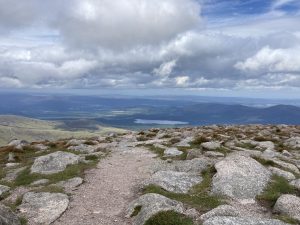
A few summers ago, up in Scotland, on a bright but wildly windy August day, I dragged my family up Cairngorm for our first Munro. I was keen. So keen, in fact, that I didn’t read the map properly and somehow managed to take us up the wrong path. (Anyone who knows Cairngorm is probably wondering how this is even possible — it’s one of the most curated, obvious routes in Scotland. Honestly, I still don’t know.)
The path we took was shorter, yes. But it was steep. Brutal, actually. There were moments I genuinely wondered if we were safe, moments I imagined us being blown clean off the mountain. The only thing that kept me going was the occasional hiker coming down, looking perfectly alive and unblown‑away.
We made it to the top in two hours — half the time I’d planned. I should have been proud. Efficient. Triumphant.
But I wasn’t. I was cross.
I had wanted a walk. A journey. The ridge. The views. The slow unfolding of a day in the mountains. Instead, I got a short, sharp slog straight up the side of a Munro. No rhythm. No beauty. No sense of movement or discovery. Just effort.
And the question that stayed with me afterwards was this: Why didn’t I turn back?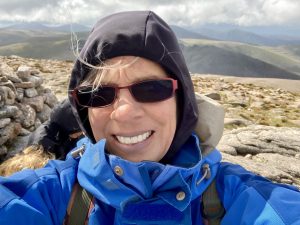
The answer, if I’m honest, was shame. I didn’t want to admit I’d got it wrong. I didn’t want to start again. I didn’t want to face the feeling of having misled my family, or myself.
But that’s the thing about experience: it doesn’t just teach you about mountains. It teaches you about you. About the parts of yourself that cling to the plan even when the plan is clearly not working. About the fear of being seen as someone who took the wrong turn. About the quiet courage it takes to say, “This isn’t the path I meant to take — let’s go back.”
Learning through experience is rarely elegant. It’s often humbling. Sometimes uncomfortable. Always instructive.
And maybe that’s the whole point. Not to get it right the first time, but to learn who you are while you’re walking — even when you’re on the wrong path, even when it’s steep, even when you wish you’d chosen differently.
That’s the real journey.